

By Leslie Spencer '79, Princetonians for Free Speech
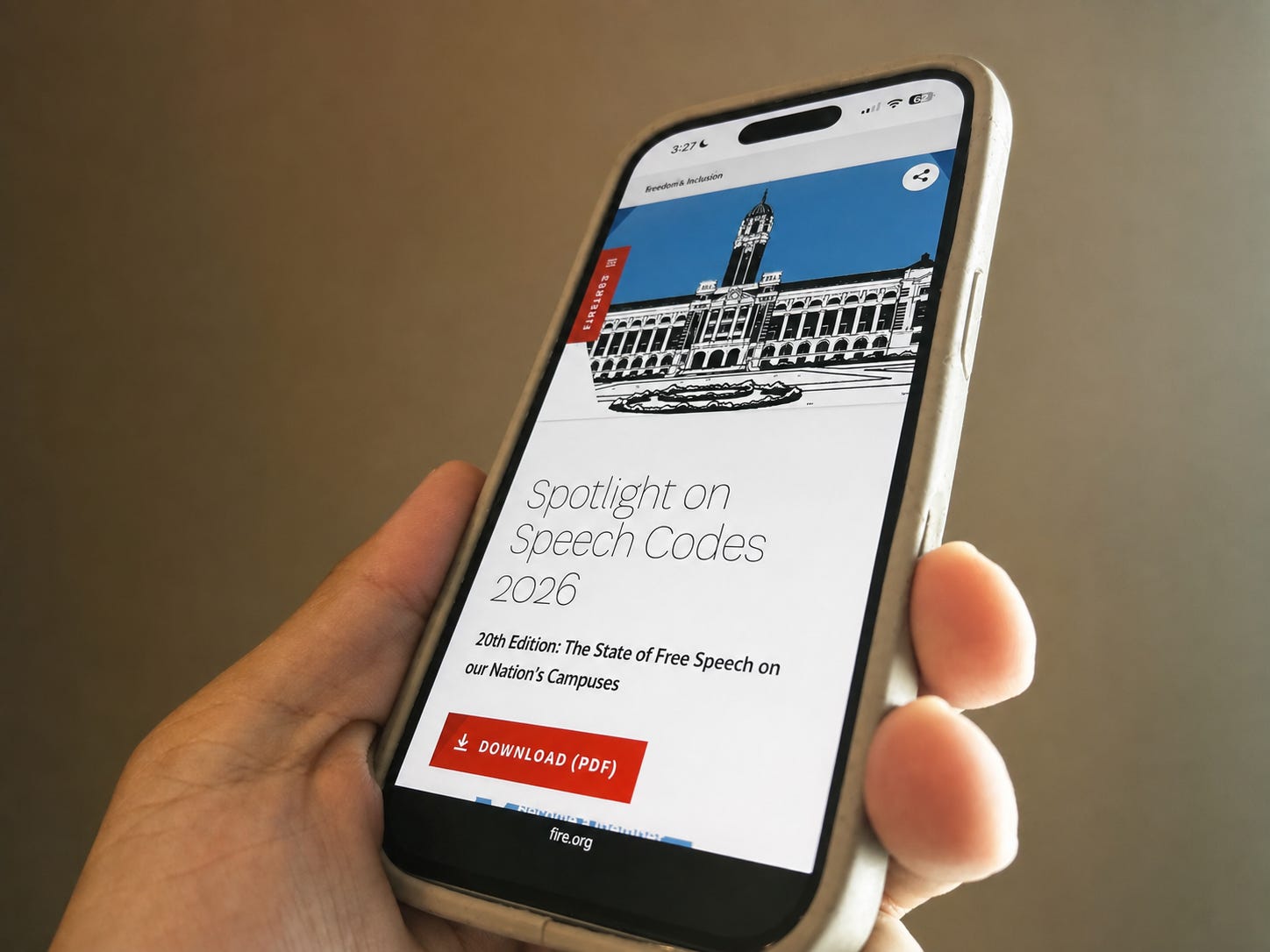
FIRE recently published its 2026 Spotlight on Speech Codes, which rates free-speech codes at 486 colleges and universities. Nationally, it found significant progress: a record number of colleges earned FIRE’s highest rating for protecting free expression, and a record low number maintained policies restricting student speech and expression that are protected by the First Amendment.
The good news is that the percentage of colleges and universities earning FIRE’s “red light” (bad) rating has reached a low of 13 percent — a 55 percent drop since the “Spotlight” report began in 2006, and a 1.5 percent drop from last year. The bad news is that Princeton is among that 13 percent. Princeton is still found to maintain policies that “clearly and substantially” restrict free expression.
Why does Princeton have a “red light” rating? FIRE points to four areas: its internet usage policies, its over-broad policies on “bias and hate speech” that could restrict protected expression, its policies on what constitutes “harassment,” and its “protest and demonstration” policies.
It would be relatively easy to change the policy language to improve Princeton’s free expression guarantees, especially since FIRE offers colleges guidance on how to improve their ratings. PFS attempted to help Princeton by working with FIRE to improve Princeton’s rating, but our efforts were ignored. This tells us that Princeton has no interest in reviewing its speech codes to improve its reputation for honoring free expression guarantees.
Princeton’s reluctance to improve its FIRE speech code rating is surprising because, in general, Princeton has strong free expression principles in place. Under President Eisgruber’s leadership, Princeton was the first university to adopt the “Chicago Statement” on free expression in 2015, after the University of Chicago created it.
However, President Eisgruber has attempted to discredit the methodology behind FIRE’s College Free Speech Rankings, both in public appearances and in his book Terms of Respect: How Colleges Get Free Speech Right. So we can assume he’s equally dismissive of FIRE’s speech code ratings, which focus solely on the places where a university’s written policies fail to meet First Amendment standards.
Major progress has been made over the last 20 years in universities’ commitment to protecting free expression, and FIRE has no doubt had a big influence on that change. Princeton is among the relatively small number of colleges that still fail the test.