

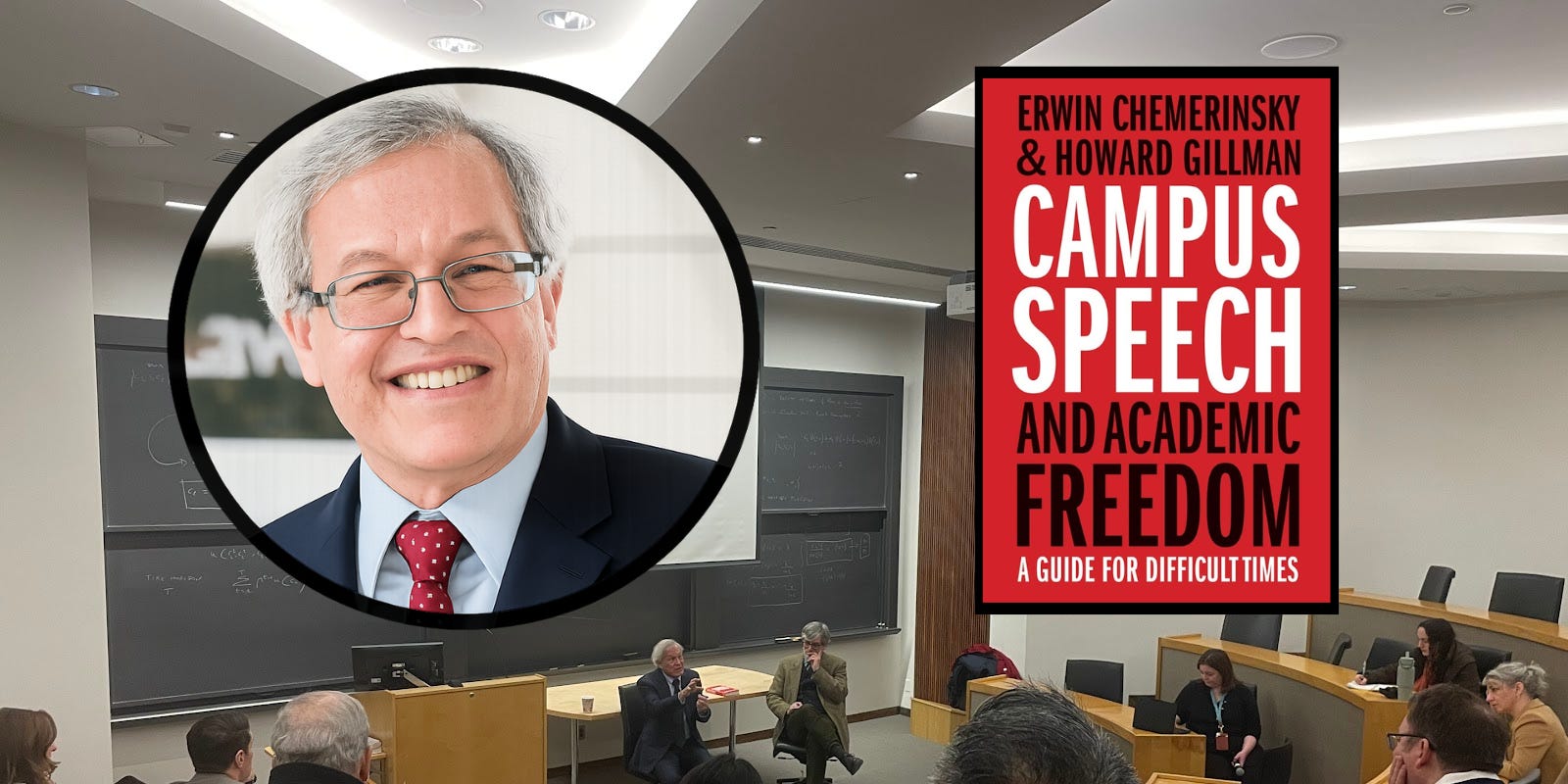
On February 19, the Princeton Council on Academic Freedom hosted Erwin Chemerinsky, Dean of the Berkeley School of Law at the University of California, Berkeley, to discuss his forthcoming book Campus Speech and Academic Freedom: A Guide for Difficult Times, co-authored with Howard Gillman. Chemerinsky described universities as operating in a moment of political pressure, as debates over Israel–Palestine, race, gender identity, and other charged issues intensify scrutiny of campus speech.
Throughout the talk, Chemerinsky argued that free speech is truly tested when we defend free expression we detest. Resisting the impulse to legislate egregious ideas is essential to preserving free expression. In his book, Chemerinsky and Gillman seek to clarify how established legal principles apply in this environment, particularly at public universities, and he warns of conflating colloquial understandings of, for example, hate speech, with the rigorous standards which apply to the legal expression of terms.
He outlined four central points. First, all ideas and viewpoints may be expressed on a college campus. At public institutions, the First Amendment prohibits the government from suppressing speech because of its content or viewpoint, even if that speech is offensive. While public universities are directly bound by the First Amendment, most private universities, including Princeton, adopt free speech rules and policies which align with First Amendment principles.
Second, the First Amendment is not absolute. Certain categories of speech are unprotected, including incitement to imminent illegal activity, true threats, and harassment. Notably, “hate speech” as such remains protected, unlike in many European countries, and attempts to define it too broadly risk granting the government authority to censor.
Third, universities may impose content-neutral time, place, and manner restrictions. Institutions can regulate when and where protests occur, so long as policies do not discriminate based on viewpoint and leave open adequate alternative channels for expression. This principle is especially relevant to contemporary issues, such as campus encampments. Questions arise when invited speakers generate extraordinary security costs and courts have not provided definitive answers.
Fourth, Chemerinsky argued that government efforts to dictate what may be taught at public universities, such as anti-critical race theory (CRT) or “Stop W.O.K.E.” laws, violate the First Amendment and threaten academic freedom. Chemerinsky described the relationship between academic freedom and the First Amendment as a venn diagram; while academic freedom overlaps with the First Amendment, it is not coextensive with it. Academic freedom is governed by professional academic standards, and courts typically defer to schools to establish these standards.
Chemerinsky warned that giving the government the ability to legislate ideas poses a far greater danger than tolerating even deeply unpopular speech.
Annabel Green ‘26, is a senior from Boulder, CO majoring in Public and International Affairs and minoring in Global Health & Health Policy. She is a PFS student writing fellow.