

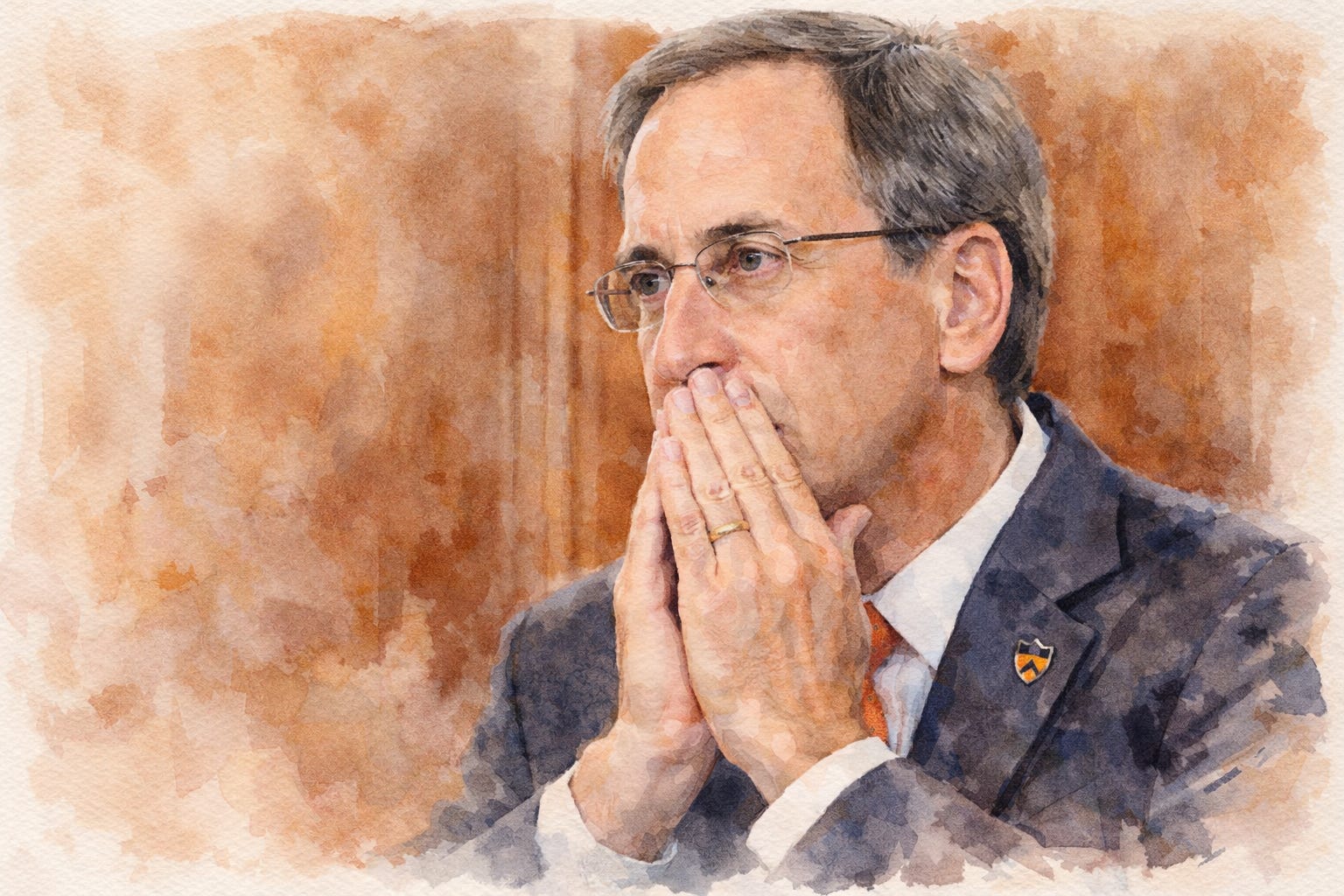
The following is the first in a multi-part review of Princeton President Christopher Eisgruber’s recent book, Terms of Respect: How Colleges Get Free Speech Right.
“When it comes to getting free speech right,” writes Princeton University President Christopher Eisgruber in the introduction to Terms of Respect, “America’s young people deserve higher marks than they get.” This is a central contention of Eisgruber’s new book, and it is, as those young people say, big – if true.
It also begs the question twice over, in the way that is all but inevitable when we talk about higher education and speech, two goods contemporarily treated as goods of themselves, if not the highest goods. Whether Eisgruber’s contention is correct depends on what is meant by free speech, then again on what is meant by getting it right.
The debate over the former is deeply confused because two terms -- “free speech” and “the freedom of speech” – are so frequently conflated, not to mention used with a liberality bordering on recklessness throughout American culture. They are different, however, and the relationship between the two is contestable. “Free speech” is a principle; “the freedom of speech” is a legal term, protection for which is enshrined in the First Amendment. Many Americans understandably believe that the law should derive from the principle: the freedom of speech ought to encompass completely free speech, to the point that nearly any law burdening expression should be invalidated as a violation of First Amendment rights. As we will see, the constitutional law scholar Eisgruber thinks that the principle should derive its contours from the legal term—though in an idiosyncratic and revealing way.
Obviously one cannot fully proceed to assess whether universities have gotten free speech right without resolving that ambiguity. Nevertheless, for now we can applaud Eisgruber for directional correctness in setting up the analytical test for answering the follow-up. Getting free speech right is the subject of his book, and he has a standard: Putting free speech in its proper place as it “relates to equality, civility, respect, and other ideals that are essential to our civic life.” Just as nations, even those with broad commitments to protecting speech embodied in their national compacts, exist for purposes above and beyond promoting free expression, universities do not exist to foster infinitely more and freer speech without regard to its content.
This will not make Eisgruber any more popular with the free-speech-maximalist crowd, who tend to believe that First Amendment protections, maximally construed and widely applied, are appropriate guides for campus administration, and who take more than a few slings in Terms of Respect. In a chapter aiming to refute the claim that college students are snowflakes—the sarcastic term for coddled students liable to melt at the first sign of discomfort—Eisgruber dismisses the work of the Foundation for Individual Rights and Expression as being overbroad and generally confusing an active two-way street with unimpeded free speech for an epidemic of heckler’s vetoes and cancellations. “FIRE consistently confuses free speech with a student culture characterized by docility or quiescence,” Eisgruber writes. “When a student group is persuaded by other students to withdraw an invitation to an antisemitic speaker,” or some similar controversy sometimes categorized as a free-speech violation, “these are core exercises of free speech, not departures from it.” Drawing out the differences between the two points of view is valuable, even if Eisgruber may overstate his case. (Some things that look like persuasion are really more like intimidation, especially in ideologically monocultural institutions where it makes sense to be vigilant in sniffing out behaviors that could chill unpopular speech.)
A Return to Civility Norms
A campus that puts free speech in its proper place, robust yet subordinated to the university’s greater purposes, will account for what Eisgruber calls “civility norms.” In a refreshing rejection of the culture that denounces civility (“tone-policing”) as a tool of oppression, Eisgruber argues that campuses must articulate and defend a set of principles alongside which speech thrives and is directed towards constructive ends. Admittedly, civility norms are not just about civility in the sense of being polite. They are “social norms that facilitate cooperation, learning, and political community” even as they are not backed up with threats of institutional repercussions. What makes gossip bad but not illegal is that it violates well-warranted norms; gossip-mongers erode universities’ good functioning by increasing distrust and turning collaborators into competitors. They use less blunt instruments than rule enforcement does. Theirs is not the realm of discipline but of favoring some behaviors over others, for the good of a purposive community. Eisgruber favors the language of civility, but you might call them pro-social or institutional norms.
It is a good concept, albeit one Eisgruber appears reluctant to apply with full rhetorical force in some of his own examples. For instance, he refers to a “shameful disruption” of social scientist Charles Murray at Middlebury College in 2017. That is underselling it a bit. A mob, spurred on by the libel that Murray is a racist, physically attacked Murray and Professor Allison Stanger, leaving Stanger concussed. The New York Times covered the aftermath: 67 students faced disciplinary action; “None of the students were suspended or expelled.” That alone should refute the notion that universities and their students have a handle on the problem. If civility norms were in force, if they even factored into the university’s calculations, things would have never gotten to that point—and Eisgruber wouldn’t have to downplay the problem so egregiously.
The focus on norms and mutual respect also dodges harder cases where civility isn’t exactly the diametric opposite of the university’s constructive purpose. Take the Princeton students who held up a flag of the terrorist group Hezbollah, for example. It’s conceivable that expressions of support for such a repugnant organization is a violation of civility norms because the group is committed to wiping out a protected national-origin group, Israelis. But the mere presence of a flag does not, or at least should not, intimidate reasonable people out of going about their daily academic lives. Does that make it OK? One is hard-pressed to say so. The example reveals that sometimes the problem is not an absence of civility, even under Eisgruber’s expansive definition, but a superabundance of stupidity, or perhaps moral backwardness.
Not Everything is a Matter of Speech
Eisgruber is right to note that too much gets lumped in or lazily described as free speech issues. But as the support for terrorism example illustrates, some of those controversies are not exactly about civility norms either.
Nevertheless, the point is well-taken. Free speech is real, a real concept that matters in many circumstances, but in order for it to remain a substantively meaningful term it has to have a circumscribed definition. If it just means ‘heated campus debate’ it is not particularly meaningful.
But for civility norms to circumscribe campus free speech – more precisely, for rules and norms to define what kind of speech is worth protecting, what kind is worth censuring, and what kind is worth censoring – campus leaders first need to be consistent in distinguishing between categories and clarifying which paradigm will apply. In this respect, Terms of Respect verges on self-refutation. A recurring story, both as Princeton’s microcosm of our national controversies and a bellwether of what would come in the intervening decade, is the story of the Black Justice League’s occupation of Eisgruber’s office in 2015. The BJL wanted to remove Woodrow Wilson’s name from campus buildings. (Allow me to take this opportunity to note that, as a student at the time, I agreed with their ends, if for different reasons.)
“The protest had undeniably illiberal aspects,” writes Eisgruber of the BJL’s tactics. “Using bullhorns to shout over people is awful behavior. Some of the protestors’ demands—for example, that the university require all faculty to complete racial sensitivity training—were inconsistent with academic freedom.” Credit to Eisgruber, throughout the book, for opposing ideological litmus tests, even those masquerading as unobjectionable forms of workplace improvement. He continues: “I wish the student protestors had chosen different means, and different vocabularies, to make their points.”
And yet—and yet! “None of that changes the fact that protest was itself an exercise of free speech.”
Of course it does! That’s exactly what it does. What good is all the talk about legitimate civility norms—not to mention time, place, and manner limitations that allow the university to function in the most quotidian sense, prerequisite to all that high-minded stuff about constructive dialogues and community—if you fall right into the trap of calling this obvious violation of free speech an exercise thereof? Who is more responsible for the lack of clarity surrounding free speech rules, norms, and principles than those who wave away violations because they sympathize with the underlying cause?
Such frustrations only mount throughout the book.
What’s the Vision, What’s the Mission?
Nevertheless, Terms of Respect does get at one important truth, at least. Universities in a time of polarization and scrutiny require “a clearly articulated vision for what the university should do.” That includes asking tough questions such as “where should they invest? ... which fields matter most to the world, to students, and to the university’s mission[?]”
Those are good questions, indeed the right questions for university leaders and administrators to ask. Yet those questions demand second- and third-order questions: What is that vision, and who, if anyone, has been brave enough to articulate it? Where do universities look to derive their sense of mission, such that they can determine what matters?
That is where Eisgruber’s deeper problems begin. As the next installments in this series will discuss, Terms of Respect betrays serious blind spots in making those judgments. Part II will examine the decades-old Supreme Court case that advanced a contestable view of “the freedom of speech” under the First Amendment and set the tone for Eisgruber’s view of free speech. We will take a close look at Eisgruber’s reliance on that case and how it helps explain universities’ spotty track record—including the persistent gap between lofty principled rhetoric and hesitating lamentable inaction—on campus controversies revolving around speech. More pertinently, an analysis of the Supreme Court’s controversial decision and the role it plays in President Eisgruber’s preferred analytical frameworks begins to cast some doubt on his big, if true, claims.
Tal Fortgang ’17 is a Legal Policy Fellow at the Manhattan Institute, a regular contributor to PFS and a contributing writer at The Dispatch.